The following article first appeared in 1928 in the Munich zither newsletter "Hausmusik." This article has been tranlsated from the original German by Jane Curtis.

For this it is necessary that the society evening not only be of zither-instructive nature but also offer a socially comfortable time. An understanding leadership here will find a rewarding field of activity. When the players go gladly to the club meetings, they need have no fear about what kind of time they will have. But a society whose members have the feeling that Tuesday or Wednesday will be a drill lesson will soon "depart that life." There are unfortunately societies in which the conductor, in complete misunderstanding of the situation, believes that the members should be treated as apprentices or military cadets. Naturally, on the other hand, sociability should not be allowed to get out if hand. Playing cards, soaking up beer, and playing party games do not belong in a zither club. Everything depends on the conductor and the president complementing and understanding each other, and on each one remaining within the realm of his own responsibilities. The conductor's job is to cultivate the musical side, the president to take care of the social and organizational tasks.
I would like the presidents of the zither societies to make the recruitment of new members their most urgent task. In the pub where the club meets, cordial invitations should be posted, visible from outside if possible, and aimed at players that are still hanging back. For example:
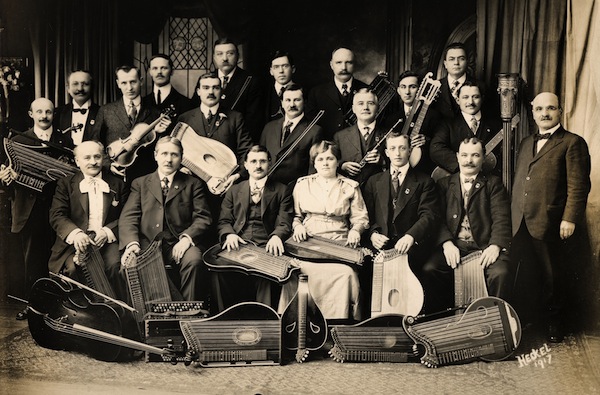
The following zither photo was sent to us by Christine Irmler. Founded in 1942, the Milwaukee Zither Club "Alpenklaenge" represents just one of many zither clubs that once flourished within the US.

This zither photo was sent to us by Trish Kellen. The Apollo Zither Club was led by Henry Schaber, pictured front and center with the conductor's baton, and was just one of several zither clubs that existed in Nebraska. This zither club image is circa 1898.
For more information on the life of Henry Schaber, see "Remembering Henry Schaber."
This zither photo of the Louisville Zither Club, taken in 1907, was sent to us by The Filson Historical Society. Oscar Below is standing in the back row, second from the right. He was a machinist who worked for the L & N Railroad and lived in the neighborhood in which the German American Club of Louisville was first established. Although not yet confirmed, it is believed the man sitting front row and center is Joseph Hugh, former director of this club.
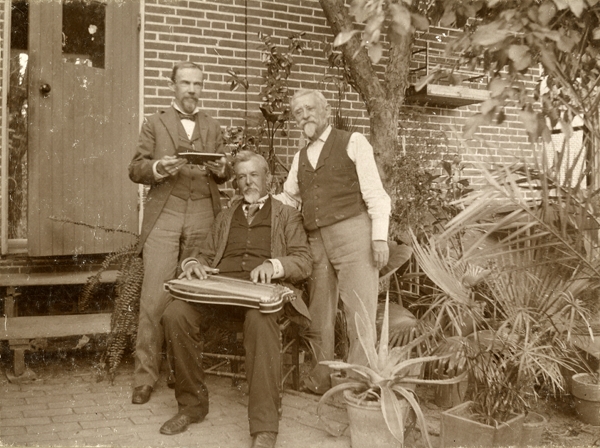
This photo of the San Antonio Zither Club (1892) comes to us courtesy of the DeGolyer Library, Southern Methodist University. It is likely that the concert zither and its predecessors, such as the scheitholt, have been in the US since Germans landed on these shores. It wasn't until the 1870s, however, that zither clubs started to form, the first being the Detroit Zither Club (1877). Over the next several decades, zither clubs could be found in a significant number of major American cities.
On Oct. 26, 1896, The Baltimore Zither Club "Harmonie" gave its first public concert at Germania Maennerchor Hall. Led by Hans Drechsel, the club thrived and performed at numerous venues in the city, such as the Bavarian National Hall and Labor Lyceum Hall. Often, zither concerts were accompanied by orchestras, singing and other forms of entertainment provided by Baltimore's numerous German-American societies.
This circa 1930 photo of the Chicago Zither Club comes to us courtesy of Jeff Baader. Jeff's grandfather, Henry Baader is shown seated in the second row, far right. Henry Baader immigrated to the US in 1927 and arrived with only a few possessions, one of which was a zither made by Ignaz Roider in Munich. Also seated in the same row, far left, is Rudy Wacek, inventor of the electric zither.
Stories and photographs of early American zither clubs and players are rare. If you have a zither related story or photograph that you would like to share, please contact us.